

Teddy Day is often misunderstood.
It’s easy to dismiss it as childish.
Too cute.
Too soft.
But emotionally, Teddy Day plays one of the most important roles in Valentine’s Week.
It’s not about romance.
It’s not about intensity.
Teddy Day is about safety.
And that’s exactly why it comes where it does.
Why Teddy Day Comes After Chocolate Day
There’s a quiet emotional progression in Valentine’s Week.
Chocolate Day offers comfort after vulnerability.
Teddy Day takes that comfort and gives it a form.
If you’ve understood why Chocolate Day is about comfort, not sweetness, you’ll notice that once emotions settle, people naturally reach for something that feels familiar, reassuring, and non-demanding.
That’s where Teddy Day fits.
A teddy isn’t a statement.
It’s a presence.
Teddy Day Isn’t Meant to Impress Anyone
Unlike earlier days in the week, Teddy Day doesn’t try to move things forward.
It doesn’t:
- push conversations
- raise expectations
- escalate feelings
Instead, it does something quieter and far more necessary.
It says:
“You’re safe here.”
That’s why Teddy Day gifts often feel more personal than romantic gestures. They don’t perform. They stay.
Who People Are Really Giving Teddy Bears To on Teddy Day
1. Someone Who Needs Reassurance, Not Romance
Teddy Day often appears in moments where emotions are steady but sensitive.
It’s for:
- someone who feels fragile
- someone navigating uncertainty
- someone who needs to feel held without being questioned
A teddy becomes a stand-in for emotional presence.
It doesn’t ask how things are going.
It simply stays.
2. New or Slowly Developing Connections
In early-stage relationships, intensity can feel overwhelming.
Teddy Day works here because it’s gentle.
It offers warmth without pressure, care without expectation. It allows closeness to grow at its own pace.
This is why people often gravitate toward soft Teddy Day gift options that evoke a sense of comfort, rather than dramatic displays.
3. Long-Distance or Emotionally Quiet Relationships
Not all closeness is physical.
For people separated by distance—or emotional reserve—a teddy becomes something constant.
Something to:
- sit on a bed
- appear in moments of loneliness
- carry comfort without conversation
In these cases, Teddy Day gifts aren’t symbolic.
They’re functional, emotional anchors.
Why Softness Is Emotionally Powerful
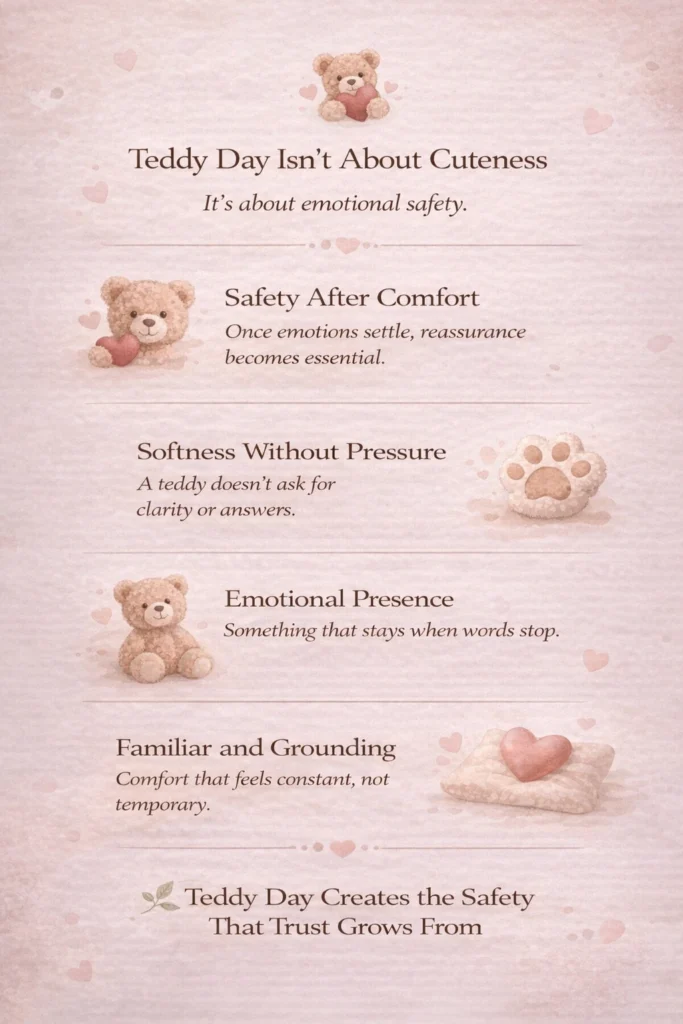
There’s a reason people associate softness with safety.
Soft textures slow us down.
They calm the nervous system.
They reduce emotional alertness.
Teddy Day taps into this instinctively.
In the emotional rhythm of Valentine’s Week:
- Rose Day acknowledged feelings.
- Propose Day expressed intent.
- Chocolate Day softened vulnerability.
Teddy Day reassures the heart.
If you step back and look at how Valentine’s Week unfolds emotionally, this placement isn’t accidental.
Teddy Day Isn’t Just for Romantic Relationships
This is where many people get it wrong.
Teddy Day is frequently used for:
- close friends
- siblings
- someone recovering from a difficult phase
- even self-soothing gestures
The common thread isn’t romance — it’s emotional safety.
A teddy says:
“You’re allowed to feel how you feel.”
And that message lands powerfully when words feel unnecessary.
What Teddy Day Makes Possible Next
Once safety is established, something shifts.
After Teddy Day, gestures often shift from comfort to trust.
That’s when people become ready to say:
- “I’m here long-term.”
- “You can count on me.”
- “This isn’t temporary.”
That shift is why Valentine’s Week doesn’t end here.
After softness comes assurance — which is exactly what the next day explores.
You’ll notice how Teddy Day naturally leads into the meaning of Promise Day, where care begins to turn into commitment.
(Forward anchor pre-written for Promise Day blog)
A Final Thought
Teddy Day doesn’t try to be impressive.
It doesn’t chase validation or reactions.
It simply offers a steady presence when emotions are settling.
In a week filled with signals, declarations, and vulnerability, Teddy Day is the pause that helps people feel grounded enough to move forward — or to simply rest where they are.
And sometimes, that’s the most meaningful gift of all.