
Somehow, Rose Day has been boxed into a single idea: romance.
Two people. One red rose. A familiar script.
But that’s not how people actually use Rose Day anymore.
If you look closely, roses on February 7 aren’t just being sent to romantic partners. They’re going to people who occupy quieter, more complicated spaces in our lives — people we care about deeply, even if the feeling doesn’t fit a label.
Rose Day isn’t about declaring love.
It’s about acknowledging emotion.
And that’s why it matters more than we think.
Rose Day Is the Softest Day of Valentine’s Week — By Design
Unlike the later days of Valentine’s Week, Rose Day doesn’t demand clarity or commitment.
It doesn’t ask:
- What are we?
- Where is this going?
- Are you really prepared to say it out loud?
It simply asks:
Who crossed your mind today?
That’s what makes it powerful.
As explored in our Valentine’s Week Gift Guide — Every Day Means Something Different, each day carries a distinct emotional role. Rose Day sets the tone. It’s about awareness, not intensity.
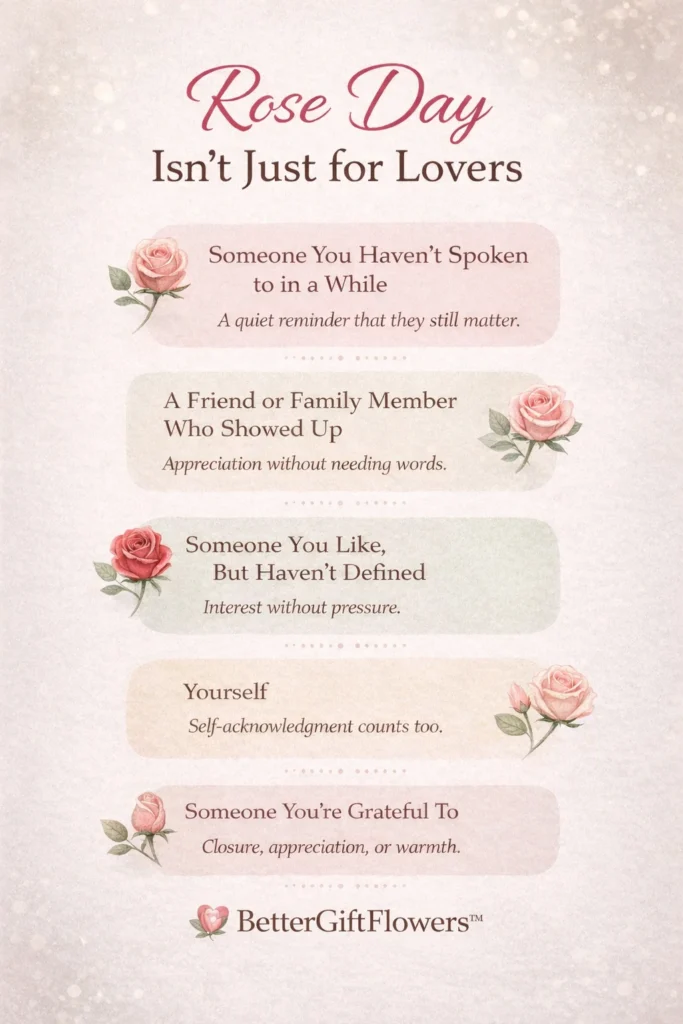
1. The Person You Haven’t Spoken to in a While
One of the most common Rose Day gestures isn’t romantic at all.
It’s sending roses to someone you’ve drifted away from — not because things went wrong, but because life got in the way.
Maybe it’s:
- an old friend
- someone you once spoke to daily
- a relationship that ended quietly, without closure
A rose here doesn’t ask for explanations. It doesn’t reopen wounds. It just says:
“I still remember you.”
And sometimes, that’s enough.
2. The Person Who Supported You, Quietly
Not all meaningful relationships are loud or visible.
Rose Day is often used to acknowledge people who’ve shown up in subtle ways:
- a sibling who always checks in
- a colleague who stood by you during a rough phase
- a friend who didn’t offer advice, just presence
Sending roses here isn’t romantic — it’s appreciative.
It’s a way of saying:
“I noticed.”
That kind of recognition, especially when unexpected, lasts longer than any grand gesture.
3. Someone You Like… But Aren’t Ready to Define Yet
This might be the most emotionally accurate use of Rose Day.
Early-stage feelings don’t always come with confidence. Sometimes there’s attraction, warmth, curiosity — but also hesitation.
Roses work beautifully here because they:
- feel thoughtful, not overwhelming
- express interest without pressure
- avoid forcing the moment forward
A rose doesn’t say “I love you.”
It says, “I feel something.”
And on Rose Day, that honesty feels right.
If you’re navigating this space, exploring Rose Day gifts online gives you options that match different emotional tones — from subtle to expressive — without locking you into a script.
4. Yourself (Yes, That Counts)
This might sound unconventional, but it’s becoming increasingly common.
People are sending roses to themselves on Rose Day.
Not as a statement — but as a quiet marker.
It can mean:
- You’ve gotten through something difficult.
- You’re choosing care over neglect.
- You don’t want to wait for validation to acknowledge your own feelings.
Buying or receiving roses for yourself completely reframes the day. It turns Rose Day from a performance into a pause.
5. Someone You Owe Gratitude To (But Never Properly Expressed)
Some people don’t fall neatly into categories like “friend” or “partner.”
They’re the ones who:
- helped you at the right time
- believed in you silently
- showed up once, but it mattered
A rose here isn’t about romance or nostalgia. It’s about emotional closure — in the best sense.
It says:
“That meant something to me.”
Why Roses Work in All These Situations
Roses have become associated with romance, but that’s only part of their emotional range.
What roses really represent is intent without explanation.
You don’t need a long message.
You don’t need a dramatic follow-up conversation.
You don’t need perfect timing.
A rose carries just enough meaning to hold space — and that’s exactly what many relationships need on Rose Day.
If distance or timing is a factor, rose bouquet delivery allows the gesture to arrive gently, without disrupting the existing rhythm.
Rose Day vs Valentine’s Day: Why This Distinction Matters
Valentine’s Day is about clarity.
Rose Day is about awareness.
That’s why Rose Day often feels more emotionally honest.
It permits people to:
- acknowledge feelings they haven’t sorted out yet
- reach out without making promises
- express care without intensity
And in modern relationships — where emotions are nuanced, and boundaries matter — that permission is powerful.
The Real Question Isn’t “Who’s Your Valentine?”
It’s:
Who are you thinking about — and why?
Rose Day makes room for that question without demanding an answer.
And that’s why roses end up traveling to many places on February 7 — not just between lovers, but across friendships, memories, gratitude, and quiet affection.
A Final Thought
Rose Day isn’t a test of romance.
It’s a moment of emotional awareness.
For some, Rose Day is where feelings surface quietly. For others, it becomes the moment that gently opens the door to expressing intention the very next day.
If someone crossed your mind today — and the feeling felt real — that’s reason enough.
Sometimes, sending a rose isn’t about making a statement.
It’s about acknowledging what already exists, quietly.