

Promise Day sounds serious.
It often gets mistaken for something dramatic. Final. Life-altering.
But emotionally, Promise Day isn’t about vows you announce loudly.
It’s about assurance—the kind that doesn’t need witnesses.
After the softness of Teddy Day, when comfort and safety have settled in, something changes. People don’t want reassurance anymore. They want to know one thing:
Can I count on you?
That’s what Promise Day exists for.
Why Promise Day Comes After Teddy Day (Not Before)
Valentine’s Week follows an emotional rhythm.
- Rose Day — awareness
- Propose Day — intention
- Chocolate Day — comfort
- Teddy Day — safety
Only after safety exists can promises feel real.
If you’ve understood why Teddy Day is about safety, not cuteness, you’ll notice that once someone feels emotionally secure, they naturally look for consistency—not passion, not excitement.
Promise Day answers that need.
Promise Day Isn’t About Big Promises
Contrary to popular belief, Promise Day rarely involves dramatic statements.
It’s not about:
- lifelong vows
- perfect certainty
- guarantees about the future
Instead, it’s about small, believable commitments.
Promises like:
- “I’ll show up.”
- “I won’t disappear when it gets hard.”
- “I’m choosing patience, not distance.”
Those are the promises people crave far more than poetic ones.
Who Promise Day Is Really For
1. Someone You Want to Reassure, Not Impress
Promise Day gestures often go to people who already trust you—but need to feel that trust reinforced.
This could be:
- a partner who’s been patient
- Someone who stood by you during uncertainty
- a relationship that’s steady but quiet
The promise here isn’t excitement.
Its reliability.
2. Relationships That Have Survived Uncertainty
Promise Day matters most when a connection has already been tested.
After:
- mixed signals
- emotional pauses
- distance or doubt
Promise Day becomes a way to say:
“I’m still here. Intentionally.”
That’s why many people choose meaningful Promise Day gifts that symbolize commitment without pressure.
3. People Who Value Actions Over Words
Some people don’t need long explanations.
For them, Promise Day isn’t verbal—it’s behavioral.
A gift given here represents:
- consistency
- dependability
- emotional maturity
The absence of drama is the point.
Why Quiet Promises Feel Stronger Than Loud Ones
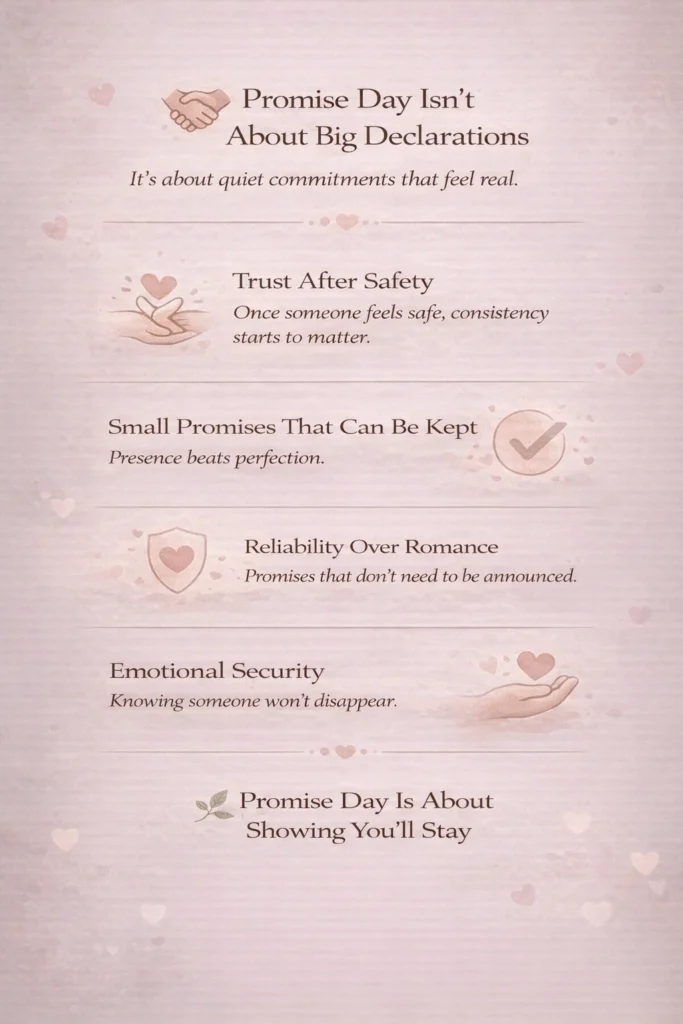
Loud promises create expectations.
Quiet ones build trust.
Promise Day works because it doesn’t demand instant belief. It allows confidence to grow naturally.
In the larger context of the Valentine’s Week gift guide, Promise Day plays a stabilizing role.
It marks the shift from feeling safe to feeling secure.
Promise Day Isn’t Just Romantic
This day is often used outside romance—and that’s overlooked.
Promise Day can be for:
- a close friend you won’t abandon
- a sibling you’ll always protect
- even yourself, after a difficult phase
The common thread isn’t romance.
It’s commitment to integrity.
What Promise Day Prepares You For Next
Once promises are made—spoken or unspoken—relationships soften.
People relax.
That’s when physical closeness starts to matter more than words.
You’ll notice that after Promise Day, gestures naturally shift from symbolic commitment to human connection.
That’s where the next day quietly steps in.
After promises, people need presence—
which is exactly what Hug Day is about.
A Final Thought
Promise Day doesn’t ask you to predict the future.
It only asks you to be honest about the present.
In a week full of emotion and expression, Promise Day is where trust takes shape—not through spectacle, but through sincerity.
And the strongest promises are often the ones spoken quietly—and kept consistently.